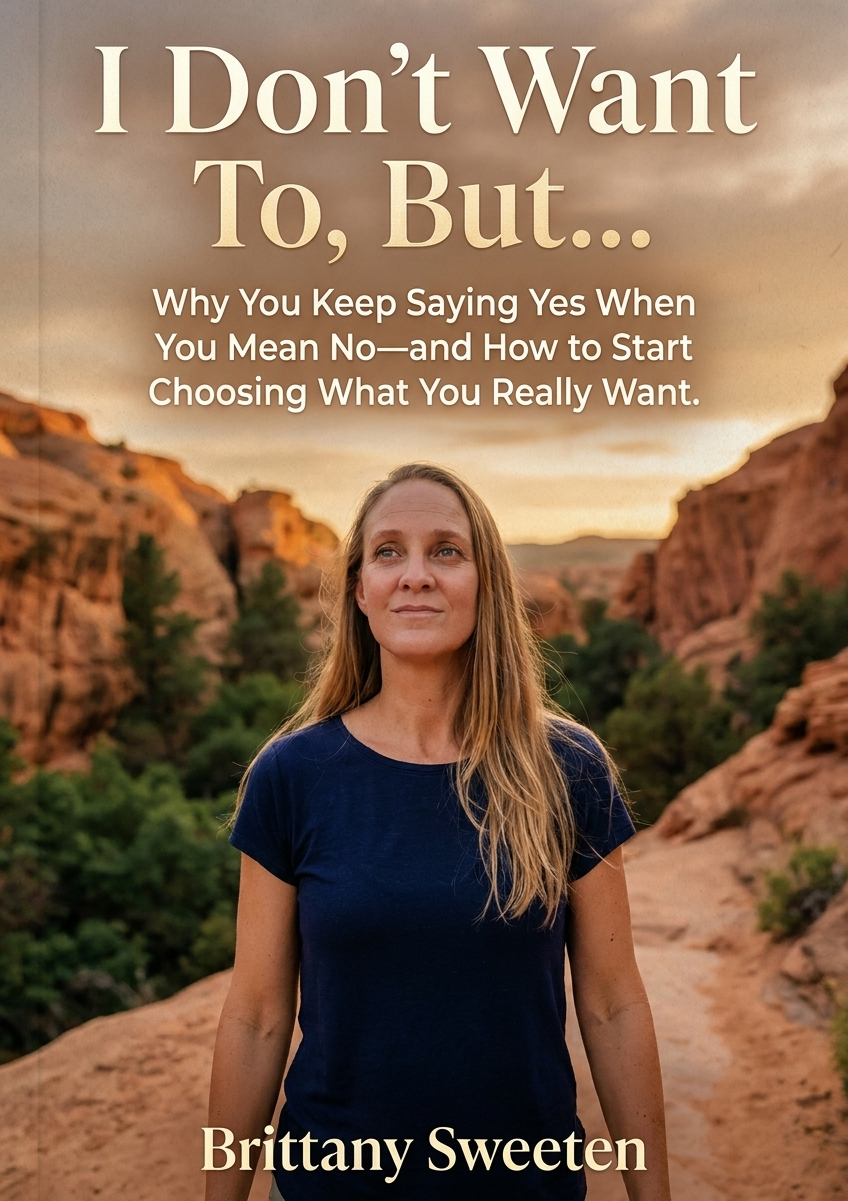
Turn down what drains you without explaining yourself or feeling guilty afterward. Get back the time and energy you’ve been giving away, and spend it on what matters to you. Every yes becomes one you mean. And it all starts before you’ve said a single word. I Don’t Want To, But… is the book for capable, caring people who are tired of saying yes when they mean no, and it shows you how to take your time, energy and life back without letting anyone down.
"You coach without knowing you are coaching."
"I had forgotten that this is what I actually want, and I'm allowed to want it."
"Every time I tried to do the opposite of what you said, exactly what you said would happen actually happened."
"I don't want to go, but they're expecting me."
"I don't want to take that on, but it's easier if I just do it."
"I don't want to, but I can manage."
Look at how that sentence is built. The first half is a few words, said quietly, often only in your head. Then comes "but," and the second half arrives with everything it needs to win. Someone's counting on you. You already agreed. You're faster at this anyway.
The second half is always longer. It usually has the better argument. And it almost always wins.
From the outside your week looks fine. You're up early, the house needs something, work needs you before work starts. Lunch gets eaten at the desk so tomorrow is lighter. Exercise happens when it fits, and even that has become a box to tick. Then an open hour shows up after dinner, and you fill it with laundry, emails, or a module from the course you paid for.
"I'll do what I want once everything's handled."
There is always something else.
If this sounds familiar, you're not alone, and you're not broken. You've been running an old system that once kept you safe, and nobody ever told it that it's allowed to stand down.
Brittany Sweeten has a name for that system. She calls it Earned Quiet. You're allowed to rest, to want things, to say no, but only after you've earned it. And since the list never ends, the quiet never arrives. Your No is still there. It just loses every argument before it finishes its sentence.
If you've done the reading, you can probably tell me the year a pattern started, which parent you learned it from, and what it was protecting you from. The belief underneath all that work is reasonable: if I understand it well enough, it will stop.
It makes sense. Insight feels like progress. Naming a pattern precisely is satisfying, and sometimes things do shift.
But a pattern you can explain can keep running. Your sister calls and asks for one more favor, and all that understanding has nothing to say while you hear yourself agreeing. Knowing why you say yes doesn't make it easier to say no in the moment someone asks.
There's a quieter version of the same trap. You can analyze a feeling from four angles, journal about it, and never once let yourself actually feel it. You can know exactly why you're sad and never give the sadness any room. Smart, self-aware people get stuck here more than anyone, because their explanations are so good.
Most of the self-help world sells more action. More learning, more tools, more methods, more fixing. Some of it helps. Brittany says so plainly in the book.
The trouble is who's doing the work. If you've spent decades being the capable one, a program hands you a list, and you know exactly what to do with a list. Working on yourself quietly turns into one more place to perform. The old sentence just gets a new ending: "I don't want to, but I'm supposed to be working on myself."
So you rearrange the furniture while water seeps under the door. The room looks better. The feeling underneath stays where it was, and it waits. Then a lamp arrives broken, or someone asks for one small thing, and you're crying in the car over something that doesn't seem big enough to explain it.
You didn't skip a module. Nobody showed you the part that comes after understanding.
My parents divorced when I was six. My mother left, and my childhood became a string of households: my dad, my three brothers, my grandparents, a stepmom for a while. At fifteen I spent a year living with my mother. At sixteen I left home.
A childhood like that writes rules. Nobody hands them to you on paper. Mine went something like this. A No must carry a reason, or you're being rude. I give in order to be loved. Rest is dangerous, because stopping means being alone with what I feel.
Those rules kept a young girl safe. Then they ran my adult life for decades.
I was a young single mother earning a biology degree and working three jobs, keeping the house steady so my daughter wouldn't know how stretched we were. Later I earned a master's in biology in Denmark. I married three times, and each time I packed up a whole version of my life and started over, believing the next one would finally feel different. The lives were often good. I kept bringing myself along.
For over six years I mentored university students. The caseload started at 80 and was pushed to 120, with no extra pay and no extra help. Nobody asked me. I loved those students, and I kept saying yes until I burnt out and left.
Then, in a workshop in October 2025, the speaker started describing a pattern, and the sound in the room began to fade. It's something my mind has done since I was young when a feeling gets too close. This time I interrupted her and asked her to say it again, slowly.
She was describing me. In every marriage, with every set of in-laws, I had made sure everyone else was okay so that I could be okay. When I needed something, I argued and justified and built my case. It was exhausting.
Underneath all of it was one rule: my needs had to make their case before they were allowed.
I'm not writing from the far side of having it all figured out. I still catch myself halfway into "Yes, I can take that." I catch it sooner now. That's what this book is for.
When you pause before you answer, you hear the first half of the sentence before the "but" shows up to overrule it.
Your No rarely arrives as words. It shows up in the body first: a tightness under the ribs, a jaw that sets, your stomach dropping when a certain name lights up your phone. Most yeses come out faster than that. If you go straight from request to answer, you skip the only place your No was trying to speak.
One slow breath interrupts the yes. The second gives some part of you time to notice you've stopped. It's short enough that nobody wonders where you went, and short enough that even the busiest part of you will agree to it.
The pause doesn't add to your list. It's the one thing in the book you can't turn into a project.
In plain terms: before you answer, you stop for two breaths, notice what your body is telling you, let that count without arguing it down, and then choose. Do that enough times and your yeses start to mean yes, and your life starts to include you.
"I was so incredibly blessed to have you as my mentor. You really seemed to understand everything I was going through."
"You coach without knowing you are coaching."
"Every time I tried to do the opposite of what you said, exactly what you said would happen actually happened."
The client Brittany calls Bread wasn't taking care of himself at all when they started. So they began small. He bought better bread. Then he added supplements, then exercise, then a treadmill.
He moved fast. There were weeks Brittany was asking him to slow down so he wouldn't burn out. Along the way he realized the biomedical degree he was earning wasn't what he wanted. He finished it anyway, went into law to become a very specific kind of lawyer who helps people, and moved to a different state.
The change Brittany cares about most is the quiet one. For years he'd been saving for a house, a car, later. Somewhere in their work, he started spending on himself, on his body and his health, now instead of someday. During the stretch when he was sitting entrance exams, listing his house and changing jobs all at once, he didn't need strategy. He had more plans than hours. What he needed was someone to sit with him long enough to feel what was happening to him.
A loaf of bread doesn't look like much. It was the first proof that he was allowed.
"I had forgotten that this is what I actually want, and I'm allowed to want it."
"A former university student found Brittany again years later to tell her how often she'd wanted to quit, how she'd cried when the material wouldn't make sense, and how grateful she was that Brittany had been there."
"Your life experiences are rough, but you still persevere with such positivity and forgiveness that proves there is a way to live better with more love and light."

Brittany Sweeten is a life transition coach and multidisciplinary scientist. She earned a biology degree as a young single mother working three jobs, then a master's in biology in Denmark. She worked in a neuroscience lab, did a research internship at the Marine Biological Laboratory at Woods Hole, and later completed a graduate certificate. For more than six years she mentored university students, many of them healthcare professionals working the front lines.
She has also started her life over three times, and learned the hard way that a new circumstance doesn't change the feeling you bring into it. Her own turning point came when she saw that her needs had always had to make their case before they were allowed.
Today she works with capable, self-aware adults going through separation, divorce, empty nests and career changes, people asking what they actually want now that the next goal no longer feels like enough. She remembers what you told her three months ago. She listens to the first few words of your sentence while everyone else hears the rest.
Her mission is simple. She wants you to include yourself in the list of people whose needs get considered.
You don't need to set aside time for this. The next time someone asks for something, or you're about to start one more task, stop and take two slow breaths before you answer. Then check in with yourself. Is your jaw tight? Did your stomach drop? Did a flat "sure" start forming before you'd even thought about it? That's your No, and the method starts with simply letting yourself hear it.
From there you let it count. You don't have to come up with a reason good enough to defend it. You make one small choice that respects what you noticed: you turn down the favor, you change the plan, you ask for help, or you leave the evening open. Afterward, notice how that choice actually felt, and keep the ones that suited you.
At first you'll probably catch your No late, days after you've already said yes. That still counts. With practice you start catching it sooner, and sometimes you'll hear it while the other person is still talking. Some pauses will feel blank, especially early on. Keep asking anyway, because you're teaching yourself that someone is listening now.
The changes are small and easy to miss from the outside. One request you answer honestly instead of automatically. One task you hand back. One open hour you leave open instead of filling it with chores. You stay as capable and caring as you've always been. And when you do say yes, you'll know it's one you mean.
You handle everything, and somewhere along the way your own wants slid to the bottom of the list. I Don't Want To, But... gives you a two-breath pause and six small steps for hearing what you actually want before you answer, so the next yes is one you mean.